Link copied!
Home Work About Blog Career Contact

What Is Document Summarisation in RAG, and Why Does It Matter?

Author: 

Paresh Bhalke

Document summarisation in RAG (Retrieval-Augmented Generation) is the process of generating structured, interpretive overviews of documents during ingestion, so the system understands what a file is about before a user ever asks a question.


Without summarisation, RAG pipelines store text but struggle to understand it. With it, they navigate knowledge.

What is the problem with basic RAG chunking?

Basic RAG pipelines treat documents like warehouses; they store information but don’t interpret it.

A standard RAG pipeline works like this:

  1. Upload documents (PDFs, manuals, contracts)
  2. Break them into chunks (typically 2,000–3,000 characters)
  3. Create vector embeddings for each chunk
  4. Store in a vector database
  5. Retrieve top-matching chunks at query time

This technically functions, but it fails in practice for one core reason: a chunk has no sense of the document it came from.

The result? Answers that are:

  • Too literal and fragment-based
  • Incomplete on cross-document questions
  • Oddly confident while missing key context
  • Unable to handle synthesis tasks like comparisons


The root cause: Retrieval relevance is not the same as answer readiness. A chunk can match a query embedding perfectly and still fail to answer the question cleanly.

How does document summarisation fix RAG retrieval?

Document summarisation gives a RAG system the same “mental ladder” a skilled human reader builds when scanning an important file.


When a human reads an insurance policy, financial report, or legal agreement, they don’t process disconnected paragraphs. They build a hierarchy:

  • What is this document about?
  • Which sections matter most?
  • What kinds of questions can this file answer?
  • What are the exclusions, caveats, and exceptions?
  • How does this document differ from similar ones?


Summarisation encodes this hierarchy directly into the RAG pipeline via:
 

Layer

What It Provides

Document summary

What the file is, what it covers

Contextual chunk descriptions

Why a specific chunk is relevant

Collection summary

How documents differ from each other

This is what makes RAG stop being a search and start being knowledge navigation.

What Is the Difference Between Basic RAG and Summary-Aware RAG?

Basic RAG

  1. Split documents into chunks
  2. Embed chunks
  3. Retrieve nearest matches
  4. Generate an answer from fragments

Behaves like: A document search assistant

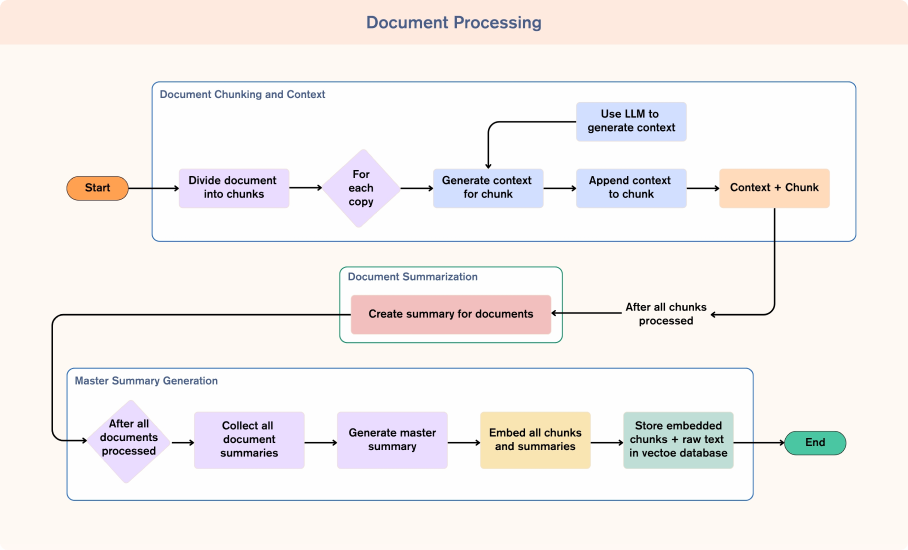
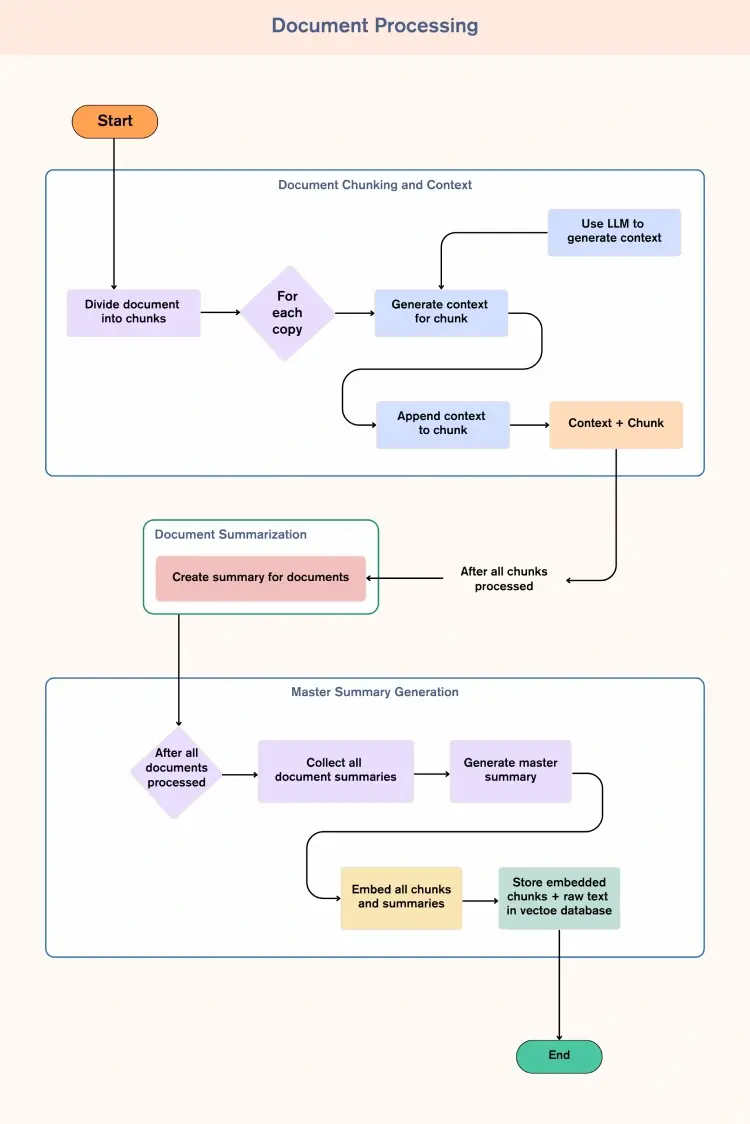
Summary-Aware RAG

  1. Split documents into chunks
  2. Create per-document summaries
  3. Generate contextual chunk descriptions
  4. Create a collection-level summary
  5. Embed enriched chunks
  6. Retrieve with semantic structure
  7. Generate answers with both detail and overview

Behaves like: Someone who has actually done the reading

The two architectures look similar on a diagram. They feel completely different in production.

Document processing Desktop
Flow chart Data Processing

Why Does Summarisation Matter for Multi-Document RAG?

Single-document retrieval is straightforward. Multi-document reasoning is where RAG breaks without summarisation.

For example, in a collection of insurance docs. Simple lookup queries, such as “What is the waiting period for cataract surgery?”, work reasonably well with chunking alone.

Enterprise users ask harder questions:

  • “Which policy has better ICU terms?”
  • “Compare PED definitions across these four providers.”
  • “What changed between these two contract versions?”
  • “Which plan offers the highest first-year benefit?”


These are synthesis tasks, not lookup tasks. Synthesis requires hierarchy. Without document-level summaries, the retriever may return:

  • A benefits table from one policy
  • A clause from another
  • An unrelated renewal paragraph
  • A bonus-related chunk that doesn’t specify first-year terms


Each chunk may score high on embedding similarity. Together, they still fail to answer the question.


A collection-level summary closes this gap. It tells the system upfront: “These five policies differ mainly on waiting periods, room rent, restoration terms, value-added services, exclusions, and claim procedures.” Now the system has a map before it starts the trip.

What Is the "Second Brain" Effect in RAG?​

Chunking stores memory. Summarisation creates judgment.

  • A vector index remembers where information lives
  • A summary helps the system understand why it matters


This creates a two-layer architecture:

  • Layer 1 remembers details (chunks)
  • Layer 2 remembers themes (summaries)


In enterprise use cases, themes matter as much as facts. When users ask broad questions, “Which one is better?”, “Anything important I should know?” “What does this say about surgery?” A chunk-only system struggles because the question itself is underspecified. A summary-aware system has more room to interpret intent.

When Does Summarisation Matter Most?

Summarisation is most critical in regulated, high-stakes, or multi-document RAG environments.

It becomes essential when your RAG system works with:

  • Insurance policies (exclusions, coverage limits, restoration clauses)
  • Legal agreements (definitions, exceptions, liability terms)
  • Healthcare documentation (treatment protocols, contraindications)
  • Compliance documents (regulatory conditions, enforcement clauses)
  • Internal policy operations (multi-version policy management)
  • Procurement and finance (contract comparisons, term sheets)


In these domains,
missing context is expensive. A system that retrieves a clause but misses its exception creates risk. A system that summarises document structure first is more likely to surface the exception.


Summarisation also improves handling of vague user queries, common in enterprise settings:

Vague query

Why summarisation helps

“Which one is better?”

Summary provides comparative anchors

“What are the differences?”

Collection summary maps variation points

“Anything important I should know?”

Document summary defines what “important” means in context

“List all policies you know about.”

Corpus inventory from collection-level summaries

Note: The domains insurance and legal are just examples, and the system is valid for any domain that needs context across documents.

What Is the Cost of Adding Summarisation to a RAG Pipeline?

Summarisation is a one-time ingestion cost, not a per-query overhead.

The complexity it adds:

  • Multiple sequential LLM calls during ingestion
  • Longer indexing workflow
  • Higher context window requirements for large documents


The payoff:

  • Cleaner retrieval on every subsequent query
  • Fewer irrelevant chunks in the prompt
  • Stronger cross-document comparisons
  • Higher-quality final answers
  • Less prompt waste


The right question is not:
“Can we skip summarisation?”


The right question is:
“How much answer quality are we losing if we do?”  In most enterprise pipelines, the answer is: more than you expect.

Key Takeaways

  • Chunking alone is not enough for high-quality RAG in enterprise settings
  • Document summaries help models understand what a file is actually about
  • Collection summaries improve multi-document reasoning and comparison queries
  • Contextual chunk descriptions boost both retrieval relevance and answer quality
  • Summarisation is a one-time ingestion cost with compounding long-term benefits
  • In enterprise RAG, summaries often determine the difference between a search tool and a reliable assistant

Want to Make Your RAG System Feel Smarter?

If you’re working with policy documents, contracts, manuals, or internal knowledge bases, summarisation is one of the highest-leverage improvements you can make to your pipeline.

Ready to see how these numbers translate to your own data?   

FAQs

Document summarisation generates structured overviews of documents during ingestion, including document-level summaries and contextual chunk annotations. These give the retrieval system interpretive scaffolding so it can answer synthesis questions, not just lookup queries.

No. Chunking splits a document into retrievable segments. Summarisation creates a higher-level understanding of what those segments mean, what the document covers, and how it relates to other documents in the corpus.

No. Summarisation happens at ingestion time, not at query time. It is a one-time processing cost that improves retrieval quality on every subsequent user query, making it a latency prevention, not a latency overhead.

Use collection-level summaries when users will ask comparative questions across multiple documents,  for example, comparing policies, contracts, or versions. A collection summary maps the key differences across the corpus so the system knows where to look before retrieval begins.

Long, structured documents with embedded exceptions, definitions, or conditional clauses benefit the most, such as insurance policies, legal agreements, compliance frameworks, operating manuals, and financial reports. These are documents where context and structure matter as much as the raw text.

Yes. When users ask under-specified questions like “which one is better” or “anything important I should know,” a summary-aware system can use document-level understanding to interpret intent. A chunk-only system has no basis for that interpretation.