AI/ML Development Services
[elementor-template id="37232"]
Full-Service Product Studio for Startups
[elementor-template id="37754"]
Developers for Hire for Product Companies
[elementor-template id="38041"]
QA and Software Testing Services
[elementor-template id="38053"]
View All Services
[elementor-template id="38057"]
Author:
LLMOps is the operational backbone that keeps AI applications running safely, efficiently, and at scale, but most teams don’t know where to start. This guide breaks down the full LLMOps lifecycle, core stack requirements, key metrics, governance controls, and a practical maturity roadmap to take your LLM from prototype to production.
LLMOps (Large Language Model Operations) is the discipline of managing large language models in production. It encompasses the people, processes, tools, and governance needed to move LLMs from experiments into reliable, cost-effective, and auditable systems that deliver business value at scale.
It can be thought of as the operational backbone that keeps AI applications running safely and efficiently, much like DevOps manages software infrastructure, LLMOps manages AI infrastructure.
LLMs present unique operational challenges:
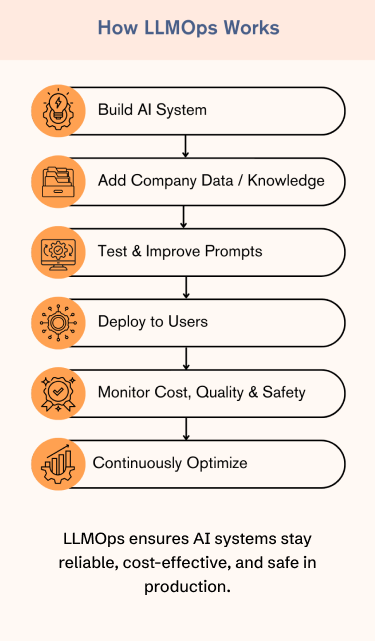
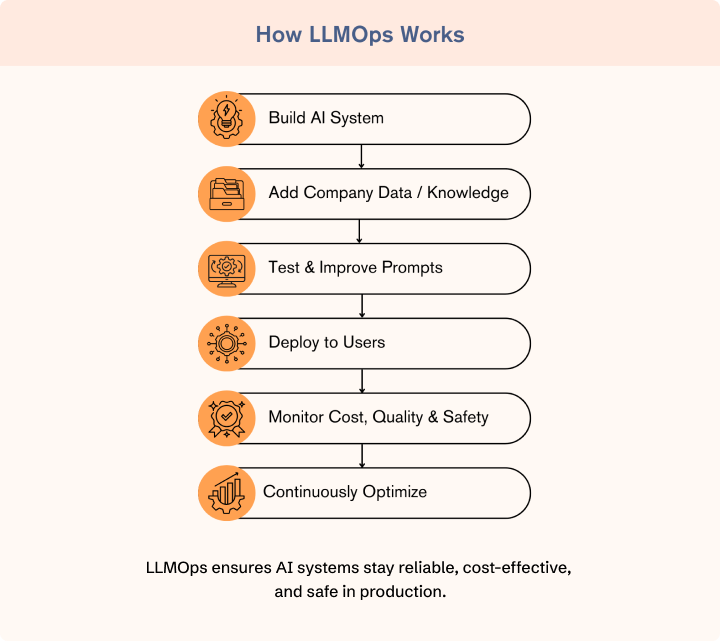
A typical LLMOps journey follows these stages:


Operationalizing LLMs requires eight interconnected layers:
Layer
What it does
Example use
Data & Grounding
Ingest, chunk, and version documents for retrieval
Prepare the company knowledge base
Model & Training
Access foundation models and fine-tune with PEFT (e.g., LoRA)
Adapt a model to your domain
Inference & Serving
High-throughput, low-latency endpoints with batching and streaming
Serve 1000s of requests/second
RAG & Embeddings
Manage vector stores, retrievers, and rerankers
Ground answers in live data
Orchestration & CI/CD
Automate pipelines; version prompts, models, and datasets
Reproduce results; enable rollbacks
Observability & Evaluation
Log prompts/completions; measure quality, cost, and drift
Detect hallucinations; track spend
Safety & Guardrails
Filter harmful inputs; enforce policies; red-team
Block prompt injection; prevent misuse
Governance & Compliance
RBAC, audit logs, retention policies, approval gates
Meet regulatory requirements
Important caveat: Automated metrics (e.g., BLEU, ROUGE, perplexity) are insufficient for LLMs. The following are needed:
Organizations must size infrastructure to meet demand. A simplified approach:
Example: 10 requests/second, 200 tokens per request, 2 GPUs @ $3/hour = ~$0.0002 per request (steady state). Peak load may require more capacity.
Challenge
Impact
Mitigation
Hallucinations
False or misleading answers damage trust
Use RAG grounding; verify facts; human review for high-risk outputs
Prompt injection
Adversaries manipulate the model via crafted inputs
Input sanitization; runtime filters; guardrails; red-team testing
Runaway costs
Token consumption exceeds budget
Token budgeting; model routing (small model for simple tasks); PEFT fine-tuning
Slow responses
Users abandon the application
Optimize inference runtime; add caching; scale GPUs; use streaming
Safety & compliance
Regulatory violations or brand damage
Automated safety checks; audit trails; approval gates; regular red-teaming
LLMOps is not optional: It is the discipline that transforms experimental LLM prototypes into production systems that are fast, safe, cost-effective, and auditable. Success requires a combination of technical tooling (versioning, RAG, inference optimization), operational discipline (logging, monitoring, approval gates), and continuous human oversight (evaluation, red-teaming, feedback loops).
Start with the fundamentals (versioning, logging, RAG), measure what matters (latency, cost, quality, safety), and scale incrementally as you gain confidence in your controls.
MLOps manages the lifecycle of traditional ML models, training, deployment, and monitoring of deterministic, retrained systems. LLMOps is a specialization that handles the unique challenges of large language models: prompt-driven behavior, non-deterministic outputs, token costs, hallucinations, and persistent vector stores. While they share principles, LLMOps requires an entirely different toolchain and operational mindset.
Yes. Even if you’re not hosting your own model, you still need to version prompts, log completions, monitor token costs, enforce safety guardrails, and manage compliance. LLMOps applies to the full application layer around the model, not just the model itself.
RAG (Retrieval-Augmented Generation) is a technique that grounds an LLM’s responses in trusted, up-to-date documents by retrieving relevant content before generating an answer. It is central to LLMOps because it directly reduces hallucinations, improves factual accuracy, and is often more cost-effective than fine-tuning a model from scratch.
Cost control in LLMOps comes down to four levers: token budgeting (setting limits per request), model routing (directing simple queries to smaller, cheaper models), caching (reusing responses for repeated inputs), and PEFT fine-tuning (adapting a smaller model to your domain so you don’t need a large one). Monitoring the cost per request as a live metric is essential for catching overruns early.