AI/ML Development Services
[elementor-template id="37232"]
Full-Service Product Studio for Startups
[elementor-template id="37754"]
Developers for Hire for Product Companies
[elementor-template id="38041"]
QA and Software Testing Services
[elementor-template id="38053"]
View All Services
[elementor-template id="38057"]
Author:
Shipping fast without breaking things isn’t luck, it’s engineering. This is how a systematic, layered test automation approach helps software teams release reliably, reduce regressions, and accelerate feedback loops from Sprint Zero.
A quality-first strategy means quality is a shared responsibility, engineered systematically at every layer of the stack, not retrofitted after the codebase has grown beyond it. The strategy is established from Sprint Zero, so tests grow alongside the product, not behind it.
A component library is the DNA of your application. In combination with a design language, it forms the base upon which your entire application is built. It closes the conversation on how the product should look and feel, the padding, the margins, the typography, and the states, before that conversation can slow your team down during complex feature development.
This is crystallized in design specifications and in component-level tests: each component is tested in complete isolation, no network, no database, no filesystem, ensuring tests are focused, fast, and deterministic. These tests live directly within the project’s codebase, co-located with the component code they cover.
To keep pace with a rapidly evolving design system, AI and AI agents, including custom-built tools and Playwright Agents, are used to drive test generation from the start and to maintain the suite as the component library grows. Once generation is complete, QAs perform a coverage check to confirm that the behavior of every component is adequately captured.
As components are assembled into pages, Playwright tests capture the interactions between them, how users flow through the application, the transitions between states, and the overall look and feel of the product as a whole. This is where component-level confidence translates into end-to-end confidence.
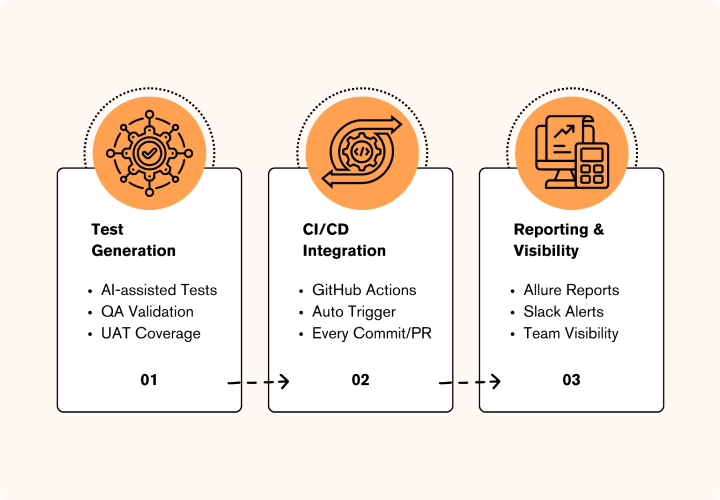
Every project follows the same three-stage pipeline, from test creation to continuous execution to immediate visibility across the team.
Stage 01: Test Generation
Components, integration, and E2E tests, covering functional and UAT scenarios, were created with AI assistance and validated by QAs.
Stage 02: CI/CD Integration
Tests are wired into GitHub Actions, running automatically on every code change. No manual steps. No waiting.
Stage 03: Reporting & Visibility
Rich Allure reports and instant Slack notifications the moment a pipeline completes, so nobody has to go looking for results.


Component Testing
The first layer validates each UI building block in complete isolation. Tests are co-located with the source code, run in milliseconds, and catch regressions the moment a change is made. AI agents handle the initial generation and self-healing brittle selectors as the design system evolves.
Integration Testing
Once individual components are verified, focus shifts to how modules, services, and APIs behave when they interact. Integration tests cover real data flows, network calls, and service dependencies, catching the bugs that unit tests alone can never surface. These are co-located with the codebase and generated with AI assistance wherever applicable.
End-to-End & UAT Testing
The final layer validates the product from the user’s perspective. Tests are structured around real user journeys and acceptance criteria, mapped directly to business requirements. Product owners and QAs perform coverage and acceptance checks together, so by the time a release is ready, every stakeholder has the confidence that the product is functionally correct and ready to ship.
Feedback arrives in minutes, not days.
Component and integration tests run on every request to protected branches, acting as a fast gate that prevents regressions from ever reaching main. E2E tests run on PRs targeting staging or production branches, and on a scheduled cadence to catch any environmental drift between releases.
Where test suites are large, parallel matrix strategies distribute the load across workers and browser configurations, keeping feedback loops tight. Failed runs retain their results, traces, and screenshots, giving developers and QAs everything they need to diagnose a failure without reproducing it locally.
Each workflow is kept focused and independent, following the Keep it simple & stupid (KISS) principle: one workflow, one clear purpose. No tangled pipelines. No complexity inherited from adjacent concerns.
Rushing into automation without a clear strategy produces brittle, hard-to-maintain test suites that become a burden rather than an asset. The most common pitfalls are:
By establishing a clear test strategy from Sprint Zero, applying the right tools at each layer, and connecting everything through a CI/CD pipeline with immediate result publishing, this approach accelerates feedback loops, enables a shift-left testing approach, and gives every project the best possible chance of shipping reliably, every time.
A quality-first test automation strategy treats quality as a shared responsibility and builds testing into development from the start. It focuses on automating high-risk, high-value scenarios with a balanced test pyramid, ensuring fast, reliable feedback through CI/CD, and continuously optimizing for defect prevention rather than just test coverage.