Link copied!
Home Work About Blog Career Contact

How to Choose a RAG Chunking Strategy (And Not Regret It Later)

Author: 

Paresh Bhalke

Your RAG system is only as good as its chunks. Pick the wrong strategy and your AI confidently retrieves the wrong answer. This guide breaks down all three approaches: speed, accuracy, cost, so your retrieval layer stops being your weakest link.

What Is Chunking in a RAG System, and Why Does It Matter?

Before an AI can search your documents, it has to break them into smaller pieces first. Those pieces are called chunks. The way you split your documents, your chunking strategy, directly determines how well your AI can find and use information later.


Think of it like filing papers. If you photocopy every page of a contract and dump them in random folders, you will spend forever hunting for the right clause. But if you organize them by topic and note what each section is about, finding the right information becomes fast and accurate.


Chunking is the same idea, applied to how an AI reads documents.

The strategy you choose has a direct impact on:

  • How accurately the AI answers questions
  • How long does it take to process new documents
  • How much of the original meaning survives in each piece


There are three main strategies used in modern RAG (Retrieval-Augmented Generation) systems:
fixed-size chunking, semantic chunking, and contextual chunking. Each works differently, and each comes with its own trade-offs.

Quick Answer: What Is Hybrid Retrieval in RAG?

For most production RAG systems dealing with complex documents (legal, insurance, finance, healthcare), contextual chunking gives the best answer quality, but at a higher processing cost. Fixed-size chunking is faster and more predictable. Semantic chunking sits in the middle.


If speed and simplicity are your priority, start with fixed-size. If accuracy on nuanced questions is non-negotiable, contextual chunking is worth the extra ingestion time.

Note: The examples are based on real health insurance policy documents from multiple companies

Strategy 1: Fixed-Size Chunking, Fast, Predictable, and Good Enough to Start

What It Is

Fixed-size chunking splits a document into chunks based on a set character or word limit, for example, every 2,000 characters. When one chunk fills up, the next begins.


Most implementations use
recursive fixed-size chunking, which tries to split at natural boundaries (like paragraph breaks or sentence ends) before falling back to a hard character cut. This avoids splitting a sentence awkwardly in the middle.


What Works Well

  • Speed: It is by far the fastest option at ingestion time. No AI model needs to read or interpret the document,  just slice and store.
  • Predictability: You always know roughly how many chunks you will get, which makes storage and cost planning straightforward.
  • Reliability: It works consistently across document types, PDFs, Word docs, plain text, anything.


The Problem

Fixed-size chunking is blind to meaning. A 3,000-character window does not know or care whether it is cutting through the middle of a clause, separating a condition from its exception, or mixing content from two different policy sections.


A chunk might read:
“the waiting period is 24 months.”

That is true and extracted correctly. But without the surrounding context, neither you nor the AI knows: 24 months for what? For which policy? Under which conditions?


Fixed-size chunking strips context, and in complex documents, context is everything.

Strategy 2: Semantic Chunking, Smarter Splits, Higher Cost

What It Is

Semantic chunking uses an AI model to understand the meaning of your document before splitting it. Instead of cutting every 3,000 characters, it identifies where topics genuinely shift, and splits there.


The result is chunks that each cover one coherent idea, rather than an arbitrary slice of text.


The Trade-Off: Processing Time

Semantic chunking is significantly more expensive during ingestion. It uses embedding models to understand the document’s structure and then splits it into meaningful segments. This process adds both computational cost and processing time because each chunking decision depends on embedding generation and similarity analysis.


When It Is Worth It

If your documents have a clear internal structure, topic by topic, section by section, and your users ask questions that stay within those topics, semantic chunking delivers cleaner, more coherent chunks with fewer accidental cross-topic blends.


For general-purpose document retrieval, the quality gain can justify the cost. For time-sensitive ingestion pipelines processing large volumes daily, the overhead may be hard to absorb.


The Remaining Problem

Even with smart splits, a semantically chunked piece can still be meaningless in isolation. A paragraph about claim exclusions in Policy A looks identical in structure to a paragraph about claim exclusions in Policy B. Without additional annotation, the AI retrieving that chunk still does not know which document it came from or how it fits into the broader picture.


This is what contextual chunking solves.

Strategy 3: Contextual Chunking: The Quality Champion

What It Is

Contextual chunking takes fixed-size or semantic chunking as a starting point, and then adds an extra step: an AI model reads each chunk and annotates it with a short description of what it means in relation to the whole document.

This annotation, often called contextual enrichment, is stored alongside the chunk. When the retrieval system searches for relevant information later, it searches not just the raw text but also the enriched context.

Why This Changes Everything

Here is a simple example of the difference:


Without contextual enrichment:

“The waiting period is 24 months.”


With contextual enrichment:

“This chunk is from Policy C, a family health insurance plan by Provider X. It describes the pre-existing disease waiting period, which is 24 months from policy inception.”


When a user asks
“Which of our policies has the shortest waiting period for pre-existing conditions?”, the contextually enriched version gives the AI exactly what it needs to answer correctly. The plain version might not even be retrieved, or worse, might be retrieved but lead to the wrong answer.


The Processing Cost

Contextual enrichment requires an LLM to read and annotate every individual chunk. For each document, you’ll need to call an LLM to generate context-aware summaries of all its chunks; adding significant latency and token costs during ingestion.

This is a one-time cost per ingestion run, not a per-query cost. Once your documents are indexed with rich contextual metadata, every search query benefits from it.


What It Gets You

Contextual chunking dramatically improves retrieval precision on complex, multi-document questions. For domains where accuracy is legally or financially important, such as insurance, healthcare, legal contracts, and compliance documents, this is not a nice-to-have. It is the difference between a system that genuinely helps and one that confidently gives wrong answers.

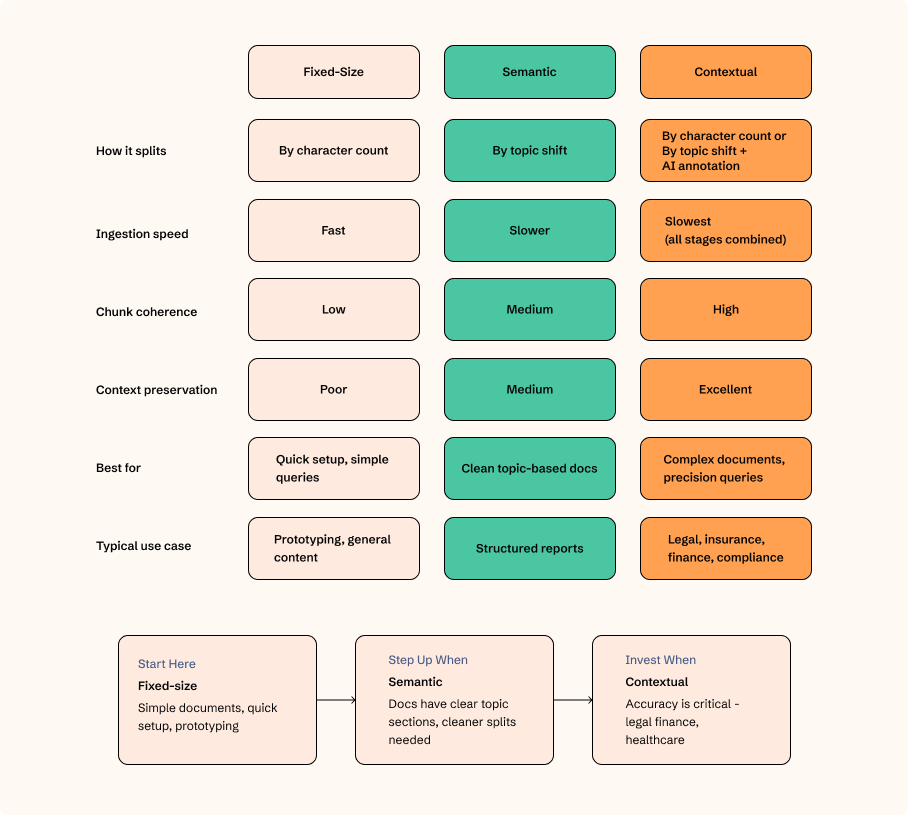
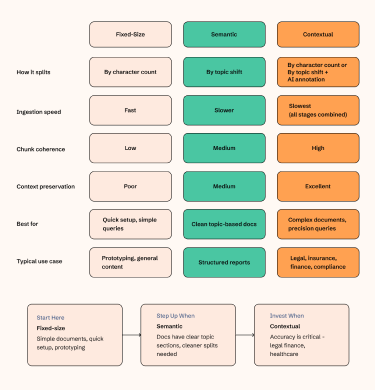
Comparison table of fixed-size, semantic, and contextual RAG chunking strategies by speed, coherence, and use case

The Bottom Line

Chunking is not just a technical detail; it is the foundation that your entire retrieval system is built on. A bad chunking strategy means the right information never reaches the AI, no matter how good the model is.

  • Start with a fixed-size if you are prototyping or working with simple documents.
  • Move to semantic chunking when your documents have distinct topic sections, and you want cleaner splits.
  • Invest in contextual chunking when your users need accurate answers on complex, domain-specific questions, and when getting those answers wrong has real consequences.


The extra ingestion time for contextual chunking is a one-time cost. The improvement in answer quality pays back on every query the system ever serves.


Still not sure which strategy fits your documents? Reach out to our team and we’ll recommend the right approach for your data. 

FAQs

A starting point of 2,000 characters per chunk works well for most document types when using fixed-size chunking. This balances specificity (each chunk covers a focused topic) with completeness (enough text for the AI to understand the content). You may need to tune this based on your document style; highly technical, dense documents may need smaller chunks; narrative-heavy documents may work better at larger sizes.

No, chunking strategy affects ingestion speed and answer quality, not search speed. Once documents are indexed, search time is consistently under one second regardless of which chunking method was used. The retrieval pipeline is fast; the impact of chunking is felt in what gets retrieved and how accurately it answers the question.

Yes, but it requires re-ingesting your documents. Your vector index is built from whatever chunks were created at ingestion time. If you change your strategy, you need to re-chunk, re-annotate (if applicable), and rebuild the index. For large document collections, plan for this cost before your initial deployment.

No, they are different things, though they are often confused. Semantic chunking changes where you split the document. Contextual chunking adds meaning metadata to each chunk after it is split. You can combine them (split semantically, then enrich contextually), or use contextual enrichment on top of fixed-size splits, which is what most production RAG systems do.

If your use case involves straightforward lookups in simple, well-structured documents,  like a knowledge base of short articles or an FAQ collection, fixed-size chunking is often sufficient. The quality gains from contextual chunking matter most when documents are long, dense, and closely related to each other (like a set of similar insurance policies or legal contracts covering related topics).

If your documents are simple and short (knowledge base articles, FAQs, product descriptions), and your users ask broad, conceptual questions rather than specific term lookups, vector-only search may be sufficient. Hybrid retrieval earns its complexity when documents are long, dense, and domain-specific, and when wrong answers have real consequences.