AI/ML Development Services
[elementor-template id="37232"]
Full-Service Product Studio for Startups
[elementor-template id="37754"]
Developers for Hire for Product Companies
[elementor-template id="38041"]
QA and Software Testing Services
[elementor-template id="38053"]
View All Services
[elementor-template id="38057"]
Author:
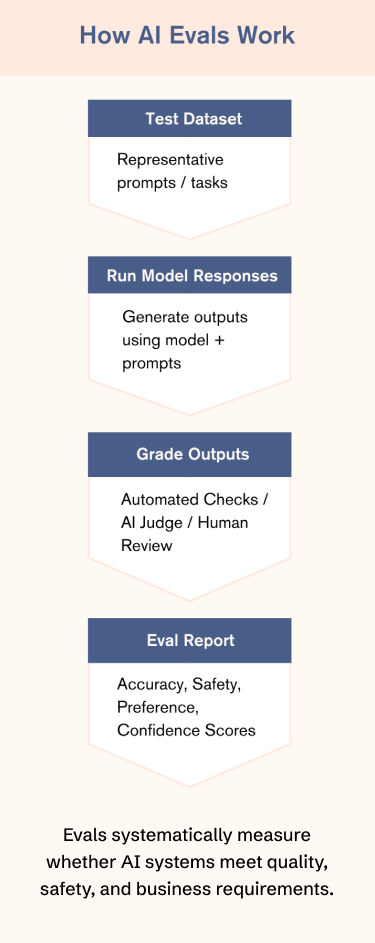
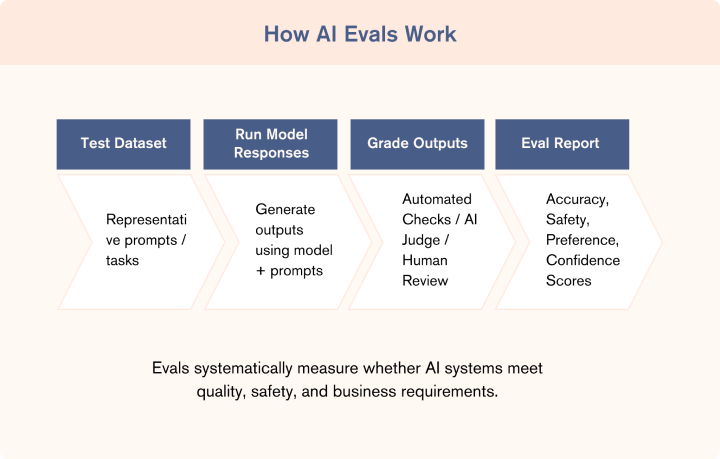
Shipping AI without evals is like deploying code without tests; you won’t know what broke until it’s already broken. This guide covers the key components, common eval types, best practices, and tools you need to build a rigorous, production-ready evaluation practice.
Evals (evaluations) are systematic, task-driven measurement exercises designed to test how well LLM-based systems perform on specific, operationally relevant tasks. Unlike public benchmarks, evals are typically tailored to a company’s unique products, workflows, and risk concerns.
Evals answer critical business questions:
Without evals, teams rely on anecdotal testing and hope; a risky approach for production AI systems.
A complete eval system includes:


Most teams use a tiered approach to control costs:
This three-stage pipeline dramatically reduces the cost of human annotation while maintaining signal quality.
Evals
Private, contextual, product-specific
Answer “Is this model right for our use case?”
Emphasis on traceability and operational metadata
Examples: internal safety tests, customer support quality checks
Benchmarks
Public, standardized, cross-model comparable
Answer “How does this model rank globally?”
Emphasis on reproducibility and leaderboard comparisons
Examples: MMLU, GSM8K, HumanEval
Evals are the bridge between research metrics and production readiness. They transform vague questions (“Is this model good?”) into measurable, reproducible, and auditable answers (“Under these specific conditions, the model achieves X performance with Y confidence”).
A mature eval practice, with versioned datasets, rigorous annotation, statistical rigor, and clear reproducibility controls, is essential for shipping safe, reliable AI products.
Evals work best as a shared responsibility. ML engineers typically build the infrastructure, product teams define what “good” looks like for their use case, and safety or policy teams own the risk-related rubrics. Without cross-functional ownership, evals tend to either miss real-world requirements or go unused in actual release decisions.
Unit tests check deterministic logic; the same input always produces the same output. Evals deal with probabilistic outputs where there is rarely one single correct answer. This means evals require rubrics, graders, and statistical aggregation rather than simple pass/fail assertions, making them fundamentally harder to design and maintain.
Yes, and it’s a real risk. If the same test set is repeatedly used to make training or fine-tuning decisions, the model can be inadvertently optimized for that specific set without genuinely improving performance on the underlying task. This is why maintaining a held-out gold set that is never used for training decisions is critical.
Treat it as a signal that your eval is miscalibrated. Either your test dataset doesn’t reflect actual usage patterns, your rubric doesn’t capture what users value, or your grader has systematic blind spots. Real-world feedback should be regularly fed back into the eval design to keep the two aligned.
Start by manually collecting 50–100 representative inputs from your intended use case, even if synthetic. Define a simple grading rubric with clear pass/fail criteria, and have two or three people grade the same outputs independently to catch ambiguity early. A small, well-designed eval beats a large, poorly labeled one every time.
model, dual failure probability is about 0.01% (one in 10,000).